Skip to article frontmatterSkip to article content
Site not loading correctly?

This may be due to an incorrect BASE_URL configuration. See the MyST Documentation for reference.

Starting point: Many-body Hamiltonian and action

We begin with a general many-body Hamiltonian for interacting particles in second quantization, H[c,c]H[c^\dagger, c], for which the partition function is given by the path integral in imaginary time,

Z=D[cˉ,c]eS[cˉ,c]S[cˉ,c]=0βdτ{1cˉ1(τ)τc1(τ)+H[c1(τ),c1(τ+0)]}=S0+SI.\begin{align} Z &= \int \mathcal{D}[\bar{c}, c] \, e^{-S[\bar{c}, c]} \\ S[\bar{c}, c] &= \int_0^\beta d\tau \left\{ \sum_1 \bar{c}_1(\tau) \partial_\tau c_1(\tau) + H[c_1^\dagger(\tau), c_1(\tau+0^-)] \right\} = S_0 + S_I\, . \end{align}

The multi-index 1 denotes all quantum numbers of the fields, e.g. momentum, spin, and orbital.

In generic notation, we can write for an arbitrary quartic interaction:

S=S0+SI=1,2cˉ1(G0)121c2141,2,3,4cˉ1cˉ3F0;1234c2c4.\begin{align} S = S_0 + S_I &= -\sum_{1,2} \bar{c}_1 (G_0)^{-1}_{12} c_2 - \frac{1}{4} \sum_{1,2,3,4} \bar{c}_1 \bar{c}_3 F_{0;1234} c_2 c_4 \, . \end{align}

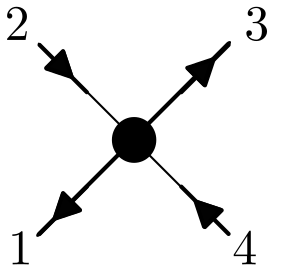
Diagrammatically, the bare four-point vertex F0F_0 is represented as the Hugenholtz diagram,

where we number the legs clockwise starting from the bottom left.

Example: Hubbard model

The Hamiltonian of the Hubbard model reads

H=tj,jσ=cjσcjσ+Ujnjnj=k,σεkckσckσ+Ujcjcjcjcj\begin{align} H &= -t \sum_{\langle j, j' \rangle} \sum_{\sigma = \uparrow \downarrow} c^\dagger_{j\sigma} c_{j \sigma} + U \sum_j n_{j\uparrow} n_{j\downarrow} \\ &= \sum_{{\bf k},\sigma} \varepsilon_{\bf k} c^\dagger_{{\bf k}\sigma} c_{{\bf k}\sigma} + U \sum_j c^\dagger_{j\uparrow} c_{j\uparrow} c^\dagger_{j\downarrow} c_{j\downarrow} \end{align}

With the Fourier transform (see also the chapter on frequency parametrizations)

cjσ(τ)=1βiνnkckσ(iνn)eikrjeiνnτ,\begin{align} c_{j\sigma}(\tau) = \frac{1}{\beta}\sum_{i\nu_n} \sum_{\bf k} c_{{\bf k}\sigma}(i\nu_n) e^{i\mathbf{k} \cdot \mathbf{r}_j} e^{-i\nu_n \tau}\, , \end{align}

the non-interacting parts of the action then reads

S0=1βiνn,k,σckσ(iνn)(iνn+εk)ckσ(iνn).\begin{align} S_0 &= \frac{1}{\beta}\sum_{i\nu_n, \mathbf{k}, \sigma} \overline{c}_{\mathbf{k}\sigma}(-i\nu_n) (-i\nu_n + \varepsilon_\mathbf{k}) c_{\mathbf{k}\sigma}(i\nu_n)\, . \end{align}

The interacting part is usually rewritten by using that ζ2=1\zeta^2=1 and suppressing the infinesimal shifts of the imaginary times,

SI=U0βdτjcj(τ)cj(τ)cj(τ)cj(τ)=U0βdτjcj(τ)cj(τ)cj(τ)cj(τ)=14 U0βdτ1dτ2dτ3dτ4j1,j2j3,j4σ1,σ2σ3,σ4cj1σ1(τ1)cj3σ3(τ3)F0;σ1σ2σ3σ4(τ1,τ2,τ3,τ4;j1,j2,j3,j4)cj2σ2(τ2)cj4σ4(τ4),\begin{align} S_I &= U \int_0^\beta d\tau \sum_j \overline{c}_{j\uparrow}(\tau) c_{j\uparrow}(\tau) \overline{c}_{j\downarrow}(\tau) c_{j\downarrow}(\tau) = U \int_0^\beta d\tau \sum_j \overline{c}_{j\uparrow}(\tau) \overline{c}_{j\downarrow}(\tau) c_{j\downarrow}(\tau) c_{j\uparrow}(\tau) \\ &= -\frac{1}{4}\ U \int_0^\beta d\tau_1 d\tau_2 d\tau_3 d\tau_4 \sum_{\substack{j_1, j_2 \\ j_3, j_4}} \sum_{\substack{\sigma_1, \sigma_2 \\ \sigma_3, \sigma_4}} \overline{c}_{j_1 \sigma_1}(\tau_1) \overline{c}_{j_3 \sigma_3}(\tau_3) F_{0; \sigma_1\sigma_2\sigma_3\sigma_4}(\tau_1,\tau_2,\tau_3,\tau_4; j_1, j_2, j_3, j_4) c_{j_2 \sigma_2}(\tau_2) c_{j_4 \sigma_4}(\tau_4)\, , \end{align}

with the antisymmetrized bare interaction term

F0;σ1σ2σ3σ4(τ1,τ2,τ3,τ4;j1,j2,j3,j4)=U(δσ1,σ4δσ3,σ2δσ1,σ2δσ3,σ4)δσ2,σ4δ(τ1=τ2=τ3=τ4)δ(j1=j2=j3=j4).\begin{align} &F_{0; \sigma_1\sigma_2\sigma_3\sigma_4}(\tau_1,\tau_2,\tau_3,\tau_4; j_1, j_2, j_3, j_4) \\ &= -U \left(\delta_{\sigma_1, \sigma_4} \delta_{\sigma_3, \sigma_2} - \delta_{\sigma_1, \sigma_2}\delta_{\sigma_3, \sigma_4}\right) \delta_{\sigma_2, \overline{\sigma}_4} \delta(\tau_1=\tau_2=\tau_3=\tau_4) \delta(j_1=j_2=j_3=j_4)\, . \end{align}

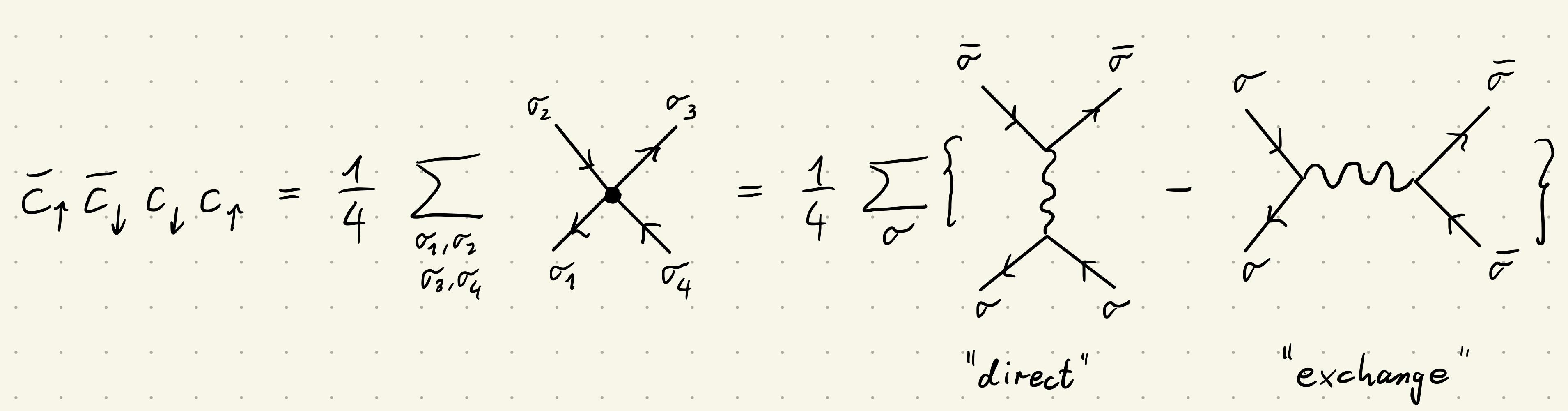
We note in passing that this antisymmetrized bare (Hugenholtz) interaction encompasses both direct and exchange scattering processes. This fact is easily seen by looking at the spin structure of the interaction term,

cccc=12(cccc)12(cccc)=14(cccc+cccccccccccc)=14σ(cσcσˉcσˉcσcσcσˉcσcσˉ)=14σ1,σ2σ3,σ4(δσ1,σ4δσ3,σ2δσ1,σ2δσ3,σ4)δσ2,σ4cσ1cσ3cσ2cσ4,\begin{align} \overline{c}_{\uparrow} \overline{c}_{\downarrow} c_{\downarrow} c_{\uparrow} &= \frac{1}{2} (\overline{c}_{\uparrow} \overline{c}_{\downarrow} - \overline{c}_{\downarrow} \overline{c}_{\uparrow}) \frac{1}{2} (c_{\downarrow} c_{\uparrow} - c_{\uparrow} c_{\downarrow}) \\ &= \frac{1}{4} (\overline{c}_{\uparrow} \overline{c}_{\downarrow} c_{\downarrow} c_{\uparrow} + \overline{c}_{\downarrow} \overline{c}_{\uparrow} c_{\uparrow} c_{\downarrow} - \overline{c}_{\uparrow} \overline{c}_{\downarrow}c_{\uparrow} c_{\downarrow} - \overline{c}_{\downarrow} \overline{c}_{\uparrow} c_{\downarrow} c_{\uparrow}) \\ &= \frac{1}{4} \sum_\sigma (\overline{c}_{\sigma} \overline{c}_{\bar{\sigma}} c_{\bar{\sigma}} c_{\sigma} - \overline{c}_{\sigma} \overline{c}_{\bar{\sigma}} c_{\sigma} c_{\bar{\sigma}}) \\ &= \frac{1}{4} \sum_{\substack{\sigma_1, \sigma_2 \\ \sigma_3, \sigma_4}} \left(\delta_{\sigma_1, \sigma_4} \delta_{\sigma_3, \sigma_2} - \delta_{\sigma_1, \sigma_2}\delta_{\sigma_3, \sigma_4}\right) \delta_{\sigma_2, \overline{\sigma}_4} \overline{c}_{\sigma_1} \overline{c}_{\sigma_3} c_{\sigma_2} c_{\sigma_4}\, , \end{align}

This convenient Hugenholtz notation ultimately leads to a great simplification of all following diagrammatics.

Fourier transforming again with the conventions laid out in the chapter on frequency parametrizations leads to

F0;σ1σ2σ3σ4(ν1,ν2,ν3,ν4;k1,k2,k3,k4)=0βdτ1dτ2dτ3dτ4eiν1τ1eiν2τ2eiν3τ3eiν4τ4j1,j2j3,j4eik1j1eik2j2eik3j3eik4j4=×F0;σ1σ2σ3σ4(τ1,τ2,τ3,τ4;j1,j2,j3,j4)=U(δσ1,σ4δσ3,σ2δσ1,σ2δσ3,σ4)δσ2,σ40βdτ1ei(ν1+ν2+ν3+ν4)τ1j1ei(k1+k2+k3+k4)j1=U(δσ1,σ4δσ3,σ2δσ1,σ2δσ3,σ4)δσ2,σ4δ(ν1+ν2+ν3+ν4)δ(k1+k2+k3+k4),\begin{align} &F_{0; \sigma_1\sigma_2\sigma_3\sigma_4}(\nu_1,\nu_2,\nu_3,\nu_4; k_1, k_2, k_3, k_4) \\ &= \int_0^\beta d\tau_1 d\tau_2 d\tau_3 d\tau_4 e^{-i\nu_1 \tau_1} e^{-i\nu_2 \tau_2} e^{-i\nu_3 \tau_3} e^{-i\nu_4 \tau_4} \sum_{\substack{j_1, j_2 \\ j_3, j_4}} e^{i k_1 j_1} e^{i k_2 j_2} e^{i k_3 j_3} e^{i k_4 j_4} \\ &\phantom{=} \times F_{0; \sigma_1\sigma_2\sigma_3\sigma_4}(\tau_1,\tau_2,\tau_3,\tau_4; j_1, j_2, j_3, j_4) \\ &= -U \left(\delta_{\sigma_1, \sigma_4} \delta_{\sigma_3, \sigma_2} - \delta_{\sigma_1, \sigma_2}\delta_{\sigma_3, \sigma_4}\right) \delta_{\sigma_2, \overline{\sigma}_4} \int_0^\beta d\tau_1 e^{-i (\nu_1 + \nu_2 + \nu_3 + \nu_4) \tau_1} \sum_{j_1} e^{i (k_1 + k_2 + k_3 + k_4) j_1} \\ &= -U \left(\delta_{\sigma_1, \sigma_4} \delta_{\sigma_3, \sigma_2} - \delta_{\sigma_1, \sigma_2}\delta_{\sigma_3, \sigma_4}\right) \delta_{\sigma_2, \overline{\sigma}_4} \delta(\nu_1 + \nu_2 + \nu_3 + \nu_4) \delta(k_1 + k_2 + k_3 + k_4)\, , \end{align}

with the proper normalization factors implied.