Frequency parametrizations
The following section also applies to the momentum dependence of one- and two-particle quantities. For concreteness and ease of notation, we focus on frequency parametrizations here. For momentum parametrizations, simply replace all frequency variables ν \nu ν ν ′ \nu' ν ′ ω \omega ω k \mathbf{k} k k ′ \mathbf{k}' k ′ q \mathbf{q} q
In thermal equilibrium, energy conservation implies that all n n n n − 1 n-1 n − 1
The first decision to make lies already in the definition of the Fourier transform from imaginary time to Matsubara frequency space: One can decide to either assign the same sign to all four frequencies or to choose different signs for incoming and outgoing particles.
Here, we choose the first option. Starting with the two-point Green’s function in imaginary time (and suppressing all further dependencies for the sake of clarity), we have
G ( ν 2 , ν 1 ) = ∫ 0 β d τ 2 d τ 1 e − i ν 2 τ 2 e − i ν 1 τ 1 G ( τ 2 , τ 1 ) . \begin{align}
G(\nu_2, \nu_1) &= \int_0^\beta d\tau_2 d\tau_1 \, e^{-i\nu_2 \tau_2} e^{-i\nu_1 \tau_1} G(\tau_2, \tau_1)\, .
\end{align} G ( ν 2 , ν 1 ) = ∫ 0 β d τ 2 d τ 1 e − i ν 2 τ 2 e − i ν 1 τ 1 G ( τ 2 , τ 1 ) . (Imaginary) time-translation invariance then implies that G G G τ 1 − τ 2 \tau_1 - \tau_2 τ 1 − τ 2 ν 2 + ν 1 = 0 \nu_2 + \nu_1 = 0 ν 2 + ν 1 = 0
G ( ν 2 , ν 1 ) ≡ G ( ν 2 ) δ ( ν 2 + ν 1 ) . \begin{align}
G(\nu_2, \nu_1) &\equiv G(\nu_2) \delta(\nu_2 + \nu_1)\, .
\end{align} G ( ν 2 , ν 1 ) ≡ G ( ν 2 ) δ ( ν 2 + ν 1 ) . The explicit form of the δ \delta δ β δ ν 2 , − ν 1 \beta \delta_{\nu_2, -\nu_1} β δ ν 2 , − ν 1 β \beta β 1 / β 1/\beta 1/ β 2 π δ ( ν 2 + ν 1 ) 2\pi \delta(\nu_2 + \nu_1) 2 π δ ( ν 2 + ν 1 ) 2 π 2\pi 2 π
Likewise, when we write down frequency integrations further below, we will denote them as ∫ ν \int_\nu ∫ ν 1 β ∑ ν \frac{1}{\beta} \sum_\nu β 1 ∑ ν ∫ d ν 2 π \int \frac{d\nu}{2\pi} ∫ 2 π d ν ζ i \zeta i ζ i ∫ ν = ∫ d ν 2 π i \int_\nu = \int \frac{d\nu}{2\pi i} ∫ ν = ∫ 2 πi d ν
The sign of the exponential in the Fourier transform is chosen such that the dynamical part of the Matsubara propagator has the canonical sign. I.e., for a Hamiltonian without a quadratic term, the bare propagator will read G 0 ( ν 2 , ν 1 ) = 1 i ν 2 δ ( ν 2 + ν 1 ) G_0(\nu_2,\nu_1) = \frac{1}{i\nu_2} \delta(\nu_2 + \nu_1) G 0 ( ν 2 , ν 1 ) = i ν 2 1 δ ( ν 2 + ν 1 )
Let’s show this explicitly in the finite-temperature Matsubara formalism. In this scenario, the bare action reads
S 0 = ∫ 0 β d τ c ‾ ( τ ) ∂ τ c ( τ ) = ∫ 0 β d τ 1 d τ 2 δ ( τ 1 − τ 2 ) c ‾ ( τ 1 ) ∂ τ 2 c ( τ 2 ) = − ∫ 0 β d τ 1 d τ 2 c ‾ ( τ 1 ) G 0 − 1 ( τ 1 , τ 2 ) c ( τ 2 ) , \begin{align}
S_0 &= \int_0^\beta d\tau\, \overline{c}(\tau) \partial_\tau c(\tau) = \int_0^\beta d\tau_1 d\tau_2\, \delta(\tau_1 - \tau_2) \, \overline{c}(\tau_1) \partial_{\tau_2} c(\tau_2) \\
&= - \int_0^\beta d\tau_1 d\tau_2\, \overline{c}(\tau_1) G_0^{-1}(\tau_1, \tau_2) c(\tau_2)\, ,
\end{align} S 0 = ∫ 0 β d τ c ( τ ) ∂ τ c ( τ ) = ∫ 0 β d τ 1 d τ 2 δ ( τ 1 − τ 2 ) c ( τ 1 ) ∂ τ 2 c ( τ 2 ) = − ∫ 0 β d τ 1 d τ 2 c ( τ 1 ) G 0 − 1 ( τ 1 , τ 2 ) c ( τ 2 ) , and hence G 0 − 1 ( τ 1 , τ 2 ) = − δ ( τ 1 − τ 2 ) ∂ τ 2 G_0^{-1}(\tau_1, \tau_2) = - \delta(\tau_1 - \tau_2) \partial_{\tau_2} G 0 − 1 ( τ 1 , τ 2 ) = − δ ( τ 1 − τ 2 ) ∂ τ 2
G 0 − 1 ( ν 1 , ν 2 ) = ∫ 0 β d τ 1 d τ 2 e − i ν 1 τ 1 G 0 − 1 ( τ 1 , τ 2 ) e − i ν 2 τ 2 = − ∫ 0 β d τ 1 d τ 2 δ ( τ 1 − τ 2 ) e − i ν 1 τ 1 ( − i ν 2 ) e − i ν 2 τ 2 = i ν 2 ∫ 0 β d τ 1 e − i ( ν 1 + ν 2 ) τ 1 = i ν 2 β δ ν 1 , − ν 2 . \begin{align}
G_0^{-1}(\nu_1,\nu_2) &= \int_0^\beta d\tau_1 d\tau_2\, e^{-i\nu_1\tau_1} G_0^{-1}(\tau_1, \tau_2) e^{-i\nu_2\tau_2} \\
&= - \int_0^\beta d\tau_1 d\tau_2\, \delta(\tau_1 - \tau_2) e^{-i\nu_1\tau_1} (-i\nu_2) e^{-i\nu_2\tau_2} \\
&= i\nu_2 \int_0^\beta d\tau_1 e^{-i(\nu_1 + \nu_2) \tau_1} = i\nu_2\, \beta \delta_{\nu_1, -\nu_2}\, .
\end{align} G 0 − 1 ( ν 1 , ν 2 ) = ∫ 0 β d τ 1 d τ 2 e − i ν 1 τ 1 G 0 − 1 ( τ 1 , τ 2 ) e − i ν 2 τ 2 = − ∫ 0 β d τ 1 d τ 2 δ ( τ 1 − τ 2 ) e − i ν 1 τ 1 ( − i ν 2 ) e − i ν 2 τ 2 = i ν 2 ∫ 0 β d τ 1 e − i ( ν 1 + ν 2 ) τ 1 = i ν 2 β δ ν 1 , − ν 2 . The bare propagator must fulfill
1 β ∑ ν 2 G 0 − 1 ( ν 1 , ν 2 ) G 0 ( ν 2 , ν 3 ) = β δ ν 1 , ν 3 , \begin{align}
\frac{1}{\beta} \sum_{\nu_2} G_0^{-1}(\nu_1, \nu_2) G_0(\nu_2, \nu_3) = \beta \delta_{\nu_1, \nu_3}\, ,
\end{align} β 1 ν 2 ∑ G 0 − 1 ( ν 1 , ν 2 ) G 0 ( ν 2 , ν 3 ) = β δ ν 1 , ν 3 , and will hence read
G ( ν 2 , ν 1 ) = 1 i ν 2 β δ ν 2 , − ν 1 , \begin{align}
\boxed{G(\nu_2, \nu_1) = \frac{1}{i\nu_2} \, \beta \delta_{\nu_2, -\nu_1}}\, ,
\end{align} G ( ν 2 , ν 1 ) = i ν 2 1 β δ ν 2 , − ν 1 , which is readily confirmed,
1 β ∑ ν 2 ( i ν 2 β δ ν 1 , − ν 2 ) ( 1 i ν 2 β δ ν 2 , − ν 3 ) = β δ ν 1 , ν 3 . ✓ \begin{align}
\frac{1}{\beta} \sum_{\nu_2} \left( i\nu_2\, \beta \delta_{\nu_1, -\nu_2} \right) \left(\frac{1}{i\nu_2} \, \beta \delta_{\nu_2, -\nu_3}\right) = \beta \delta_{\nu_1, \nu_3}\, . \ \checkmark
\end{align} β 1 ν 2 ∑ ( i ν 2 β δ ν 1 , − ν 2 ) ( i ν 2 1 β δ ν 2 , − ν 3 ) = β δ ν 1 , ν 3 . ✓ The Fourier transform of the two-particle vertex reads
F ( ν 1 , ν 2 , ν 3 , ν 4 ) = ∫ 0 β d τ 1 d τ 2 d τ 3 d τ 4 e − i ν 1 τ 1 e − i ν 2 τ 2 e − i ν 3 τ 3 e − i ν 4 τ 4 F ( τ 1 , τ 2 , τ 3 , τ 4 ) , \begin{align}
F(\nu_1, \nu_2, \nu_3, \nu_4) = \int_0^\beta d\tau_1 d\tau_2 d\tau_3 d\tau_4 \, &e^{-i\nu_1 \tau_1} e^{-i\nu_2 \tau_2} e^{-i\nu_3 \tau_3} e^{-i\nu_4 \tau_4} F(\tau_1, \tau_2, \tau_3, \tau_4) \, ,
\end{align} F ( ν 1 , ν 2 , ν 3 , ν 4 ) = ∫ 0 β d τ 1 d τ 2 d τ 3 d τ 4 e − i ν 1 τ 1 e − i ν 2 τ 2 e − i ν 3 τ 3 e − i ν 4 τ 4 F ( τ 1 , τ 2 , τ 3 , τ 4 ) , with energy conservation implying ν 1 + ν 2 + ν 3 + ν 4 = 0 \nu_1 + \nu_2 + \nu_3 + \nu_4 = 0 ν 1 + ν 2 + ν 3 + ν 4 = 0 F ( ν 1 , ν 2 , ν 3 , ν 4 ) ∼ δ ( ν 1 + ν 2 + ν 3 + ν 4 ) F(\nu_1, \nu_2, \nu_3, \nu_4) \sim \delta(\nu_1 + \nu_2 + \nu_3 + \nu_4) F ( ν 1 , ν 2 , ν 3 , ν 4 ) ∼ δ ( ν 1 + ν 2 + ν 3 + ν 4 )
This choice for defining the Fourier transform is the common one used in the Vienna convention. In the Munich convention, one would instead define
G ( ν 2 , ν 1 ) = ∫ 0 β d τ 2 d τ 1 e i ν 2 τ 2 e − i ν 1 τ 1 G ( τ 2 , τ 1 ) F ( ν 1 , ν 2 , ν 3 , ν 4 ) = ∫ 0 β d τ 1 d τ 2 d τ 3 d τ 4 e i ν 1 τ 1 e − i ν 2 τ 2 e i ν 3 τ 3 e − i ν 4 τ 4 F ( τ 1 , τ 2 , τ 3 , τ 4 ) . \begin{align}
G(\nu_2, \nu_1) &= \int_0^\beta d\tau_2 d\tau_1 \, e^{i\nu_2 \tau_2} e^{-i\nu_1 \tau_1} G(\tau_2, \tau_1) \\
F(\nu_1, \nu_2, \nu_3, \nu_4) &= \int_0^\beta d\tau_1 d\tau_2 d\tau_3 d\tau_4 \, e^{i\nu_1 \tau_1} e^{-i\nu_2 \tau_2} e^{i\nu_3 \tau_3} e^{-i\nu_4 \tau_4} F(\tau_1, \tau_2, \tau_3, \tau_4) \, .
\end{align} G ( ν 2 , ν 1 ) F ( ν 1 , ν 2 , ν 3 , ν 4 ) = ∫ 0 β d τ 2 d τ 1 e i ν 2 τ 2 e − i ν 1 τ 1 G ( τ 2 , τ 1 ) = ∫ 0 β d τ 1 d τ 2 d τ 3 d τ 4 e i ν 1 τ 1 e − i ν 2 τ 2 e i ν 3 τ 3 e − i ν 4 τ 4 F ( τ 1 , τ 2 , τ 3 , τ 4 ) . Remember that the role of incoming and outgoing frequencies is interchanged between correlation functions and vertices. With this definition, energy conservation implies ν 1 = ν 2 \nu_1 = \nu_2 ν 1 = ν 2 ν 1 + ν 3 = ν 2 + ν 4 \nu_1 + \nu_3 = \nu_2 + \nu_4 ν 1 + ν 3 = ν 2 + ν 4
This difference in convention then propagates to all subsequent definitions of frequency parametrizations.
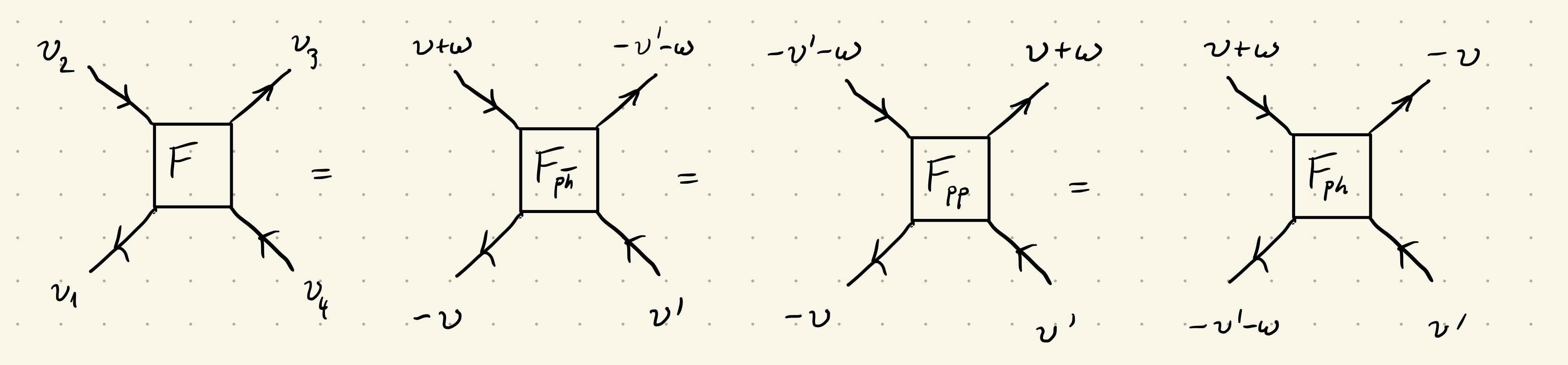
The next choice to make is which three frequencies to use as independent variables. Here, it is common to choose linear combinations of the four original frequencies that reflect the physical processes occurring in the three different two-particle channels p h ‾ \overline{ph} p h p p pp pp p h ph p h ν \nu ν ν ′ \nu' ν ′ ω \omega ω ν \nu ν ν ′ \nu' ν ′ ω \omega ω
One natural choice for these channel-native frequency parametrizations (consistent with a large part of the Vienna community) is given by
p h ‾ : ν 1 = − ν p p : ν 1 = − ν p h : ν 1 = − ν ′ − ω ν 2 = ν + ω ν 2 = − ν ′ − ω ν 2 = ν + ω ν 3 = − ν ′ − ω ν 3 = ν + ω ν 3 = − ν ν 4 = ν ′ ν 4 = ν ′ ν 4 = ν ′ . \begin{align}
\overline{ph}: \ \nu_1 &= -\nu &\ pp:\ \nu_1 &= -\nu &\ ph:\ \nu_1 &= -\nu'-\omega \\
\nu_2 &= \nu + \omega &\ \nu_2 &= -\nu' - \omega &\ \nu_2 &= \nu + \omega \\
\nu_3 &= -\nu' - \omega &\ \nu_3 &= \nu + \omega &\ \nu_3 &= -\nu \\
\nu_4 &= \nu' &\ \nu_4 &= \nu' &\ \nu_4 &= \nu' \, .
\end{align} p h : ν 1 ν 2 ν 3 ν 4 = − ν = ν + ω = − ν ′ − ω = ν ′ pp : ν 1 ν 2 ν 3 ν 4 = − ν = − ν ′ − ω = ν + ω = ν ′ p h : ν 1 ν 2 ν 3 ν 4 = − ν ′ − ω = ν + ω = − ν = ν ′ . The parametrizations are identical for the p h ‾ \overline{ph} p h p h ph p h ν 1 ↔ ν 3 \nu_1 \leftrightarrow \nu_3 ν 1 ↔ ν 3
This parametrization is illustrated in the following diagram:
We can thus parametrize the vertex in each channel as
F ( ν 1 , ν 2 , ν 3 , ν 4 ) ≡ F p h ‾ ( ν , ν ′ , ω ) = F p h ‾ ( − ν 1 , ν 4 , ν 1 + ν 2 ) δ ( ν 1 + ν 2 + ν 3 + ν 4 ) ≡ F p p ( ν , ν ′ , ω ) = F p p ( − ν 1 , ν 4 , ν 1 + ν 3 ) δ ( ν 1 + ν 2 + ν 3 + ν 4 ) ≡ F p h ( ν , ν ′ , ω ) = F p h ( − ν 3 , ν 4 , ν 3 + ν 2 ) δ ( ν 1 + ν 2 + ν 3 + ν 4 ) . \begin{align}
F(\nu_1, \nu_2, \nu_3, \nu_4) &\equiv F^{\overline{ph}}(\nu, \nu', \omega) = F^{\overline{ph}}(-\nu_1, \nu_4, \nu_1 + \nu_2) \delta(\nu_1 + \nu_2 + \nu_3 + \nu_4) \\
&\equiv F^{pp}(\nu, \nu', \omega) = F^{pp}(-\nu_1, \nu_4, \nu_1 + \nu_3) \delta(\nu_1 + \nu_2 + \nu_3 + \nu_4) \\
&\equiv F^{ph}(\nu, \nu', \omega) = F^{ph}(-\nu_3, \nu_4, \nu_3 + \nu_2) \delta(\nu_1 + \nu_2 + \nu_3 + \nu_4)\, .
\end{align} F ( ν 1 , ν 2 , ν 3 , ν 4 ) ≡ F p h ( ν , ν ′ , ω ) = F p h ( − ν 1 , ν 4 , ν 1 + ν 2 ) δ ( ν 1 + ν 2 + ν 3 + ν 4 ) ≡ F pp ( ν , ν ′ , ω ) = F pp ( − ν 1 , ν 4 , ν 1 + ν 3 ) δ ( ν 1 + ν 2 + ν 3 + ν 4 ) ≡ F p h ( ν , ν ′ , ω ) = F p h ( − ν 3 , ν 4 , ν 3 + ν 2 ) δ ( ν 1 + ν 2 + ν 3 + ν 4 ) . Another main benefit of these channel-native frequency parametrizations is that only two instead of all three frequencies enter the bubble χ 0 \chi_0 χ 0 two-particle channels
[ χ 0 ] 4321 ( ν 2 , ν 1 ) = G 41 ( ν 2 ) G 23 ( ν 1 ) , \begin{align}
[\chi_0]_{4321}(\nu_2, \nu_1) &= G_{41}(\nu_2) G_{23}(\nu_1) \, ,
\end{align} [ χ 0 ] 4321 ( ν 2 , ν 1 ) = G 41 ( ν 2 ) G 23 ( ν 1 ) , where the indices in the subscripts now denote all dependencies other than frequency. In the three channels, we define
[ χ 0 p h ‾ ] 4321 ( ν , ω ) = [ χ 0 ] 4321 ( ν , ν + ω ) [ χ 0 p p ] 4321 ( ν , ω ) = 1 2 [ χ 0 ] 4321 ( ν , − ν − ω ) [ χ 0 p h ] 4321 ( ν , ω ) = ζ [ χ 0 ] 2341 ( ν , ν + ω ) . \begin{align}
[\chi_0^{\overline{ph}}]_{4321}(\nu, \omega) &= [\chi_0]_{4321}(\nu, \nu + \omega) \\
[\chi_0^{pp}]_{4321}(\nu, \omega) &= \frac{1}{2} [\chi_0]_{4321}(\nu, -\nu - \omega) \\
[\chi_0^{ph}]_{4321}(\nu, \omega) &= \zeta [\chi_0]_{2341}(\nu, \nu + \omega)\, .
\end{align} [ χ 0 p h ] 4321 ( ν , ω ) [ χ 0 pp ] 4321 ( ν , ω ) [ χ 0 p h ] 4321 ( ν , ω ) = [ χ 0 ] 4321 ( ν , ν + ω ) = 2 1 [ χ 0 ] 4321 ( ν , − ν − ω ) = ζ [ χ 0 ] 2341 ( ν , ν + ω ) . We furthermore define the filled connector symbol ∙ \bullet ∙ two-particle channels except frequency. Then, we can write down the bubble contractions in each channel r r r
[ A ∘ χ 0 r ∘ B ] ( ν , ν ′ , ω ) = ∫ ν ′ ′ A ( ν , ν ′ ′ , ω ) ∙ χ 0 r ( ν ′ ′ , ω ) ∙ B ( ν ′ ′ , ν ′ , ω ) , \begin{align}
[A \circ \chi_0^r \circ B](\nu, \nu', \omega) &= \int_{\nu''} A(\nu, \nu'', \omega) \bullet \chi_0^r(\nu'', \omega) \bullet B(\nu'', \nu', \omega) \, ,
\end{align} [ A ∘ χ 0 r ∘ B ] ( ν , ν ′ , ω ) = ∫ ν ′′ A ( ν , ν ′′ , ω ) ∙ χ 0 r ( ν ′′ , ω ) ∙ B ( ν ′′ , ν ′ , ω ) , where A A A B B B r r r
In the p h ‾ \overline{ph} p h
[ A ∘ χ 0 p h ‾ ∘ B ] ( ν 1 , ν 2 , ν 3 , ν 4 ) = [ A ∘ χ 0 p h ‾ ∘ B ] ( − ν 1 , ν 4 , ν 1 + ν 2 ) δ ( ν 1 + ν 2 + ν 3 + ν 4 ) = ∫ ν 5 , ν 6 ν 7 , ν 8 A ( ν 1 , ν 2 , ν 5 , ν 6 ) G ( ν 6 , ν 7 ) G ( ν 8 , ν 5 ) B ( ν 7 , ν 8 , ν 3 , ν 4 ) = ∫ ν 6 , ν 8 A ( ν 1 , ν 2 , − ν 8 , ν 6 ) G ( ν 6 ) G ( ν 8 ) B ( − ν 6 , ν 8 , ν 3 , ν 4 ) = ∫ ν 6 , ν 8 A ( − ν 1 , ν 6 , ν 1 + ν 2 ) δ ( ν 1 + ν 2 − ν 8 + ν 6 ) G ( ν 6 ) G ( ν 8 ) B ( ν 6 , ν 4 , ν 8 − ν 6 ) δ ( − ν 6 + ν 8 + ν 3 + ν 4 ) = ∫ ν 6 A ( − ν 1 , ν 6 , ν 1 + ν 2 ) G ( ν 6 ) G ( ν 6 + ν 1 + ν 2 ) B ( ν 6 , ν 4 , ν 1 + ν 2 ) δ ( ν 1 + ν 2 + ν 3 + ν 4 ) , \begin{align}
[A \circ \chi_0^{\overline{ph}} \circ B](\nu_1, \nu_2, \nu_3, \nu_4) &= [A \circ \chi_0^{\overline{ph}} \circ B](-\nu_1, \nu_4, \nu_1 + \nu_2) \delta(\nu_1 + \nu_2 + \nu_3 + \nu_4) \\
&= \int_{\substack{\nu_5,\nu_6 \\ \nu_7,\nu_8}} A(\nu_1, \nu_2, \nu_5, \nu_6) G(\nu_6, \nu_7) G(\nu_8, \nu_5) B(\nu_7, \nu_8, \nu_3, \nu_4) \\
&= \int_{\nu_6, \nu_8} A(\nu_1, \nu_2, -\nu_8, \nu_6) G(\nu_6) G(\nu_8) B(-\nu_6, \nu_8, \nu_3, \nu_4) \\
&= \int_{\nu_6, \nu_8} A(-\nu_1, \nu_6, \nu_1 + \nu_2) \delta(\nu_1 + \nu_2 - \nu_8 + \nu_6) G(\nu_6) G(\nu_8) B(\nu_6, \nu_4, \nu_8 - \nu_6) \delta(-\nu_6 + \nu_8 + \nu_3 + \nu_4) \\
&= \int_{\nu_6} A(-\nu_1, \nu_6, \nu_1 + \nu_2) G(\nu_6) G(\nu_6 + \nu_1 + \nu_2) B(\nu_6, \nu_4, \nu_1 + \nu_2) \delta(\nu_1 + \nu_2 + \nu_3 + \nu_4)\, ,
\end{align} [ A ∘ χ 0 p h ∘ B ] ( ν 1 , ν 2 , ν 3 , ν 4 ) = [ A ∘ χ 0 p h ∘ B ] ( − ν 1 , ν 4 , ν 1 + ν 2 ) δ ( ν 1 + ν 2 + ν 3 + ν 4 ) = ∫ ν 5 , ν 6 ν 7 , ν 8 A ( ν 1 , ν 2 , ν 5 , ν 6 ) G ( ν 6 , ν 7 ) G ( ν 8 , ν 5 ) B ( ν 7 , ν 8 , ν 3 , ν 4 ) = ∫ ν 6 , ν 8 A ( ν 1 , ν 2 , − ν 8 , ν 6 ) G ( ν 6 ) G ( ν 8 ) B ( − ν 6 , ν 8 , ν 3 , ν 4 ) = ∫ ν 6 , ν 8 A ( − ν 1 , ν 6 , ν 1 + ν 2 ) δ ( ν 1 + ν 2 − ν 8 + ν 6 ) G ( ν 6 ) G ( ν 8 ) B ( ν 6 , ν 4 , ν 8 − ν 6 ) δ ( − ν 6 + ν 8 + ν 3 + ν 4 ) = ∫ ν 6 A ( − ν 1 , ν 6 , ν 1 + ν 2 ) G ( ν 6 ) G ( ν 6 + ν 1 + ν 2 ) B ( ν 6 , ν 4 , ν 1 + ν 2 ) δ ( ν 1 + ν 2 + ν 3 + ν 4 ) , where we used that ∫ ν 8 δ ( ν 1 + ν 2 − ν 8 + ν 6 ) δ ( − ν 6 + ν 8 + ν 3 + ν 4 ) = δ ( ν 1 + ν 2 + ν 3 + ν 4 ) \int_{\nu_8} \delta(\nu_1 + \nu_2 - \nu_8 + \nu_6) \delta(-\nu_6 + \nu_8 + \nu_3 + \nu_4) = \delta(\nu_1 + \nu_2 + \nu_3 + \nu_4) ∫ ν 8 δ ( ν 1 + ν 2 − ν 8 + ν 6 ) δ ( − ν 6 + ν 8 + ν 3 + ν 4 ) = δ ( ν 1 + ν 2 + ν 3 + ν 4 ) ν 8 = ν 6 + ν 1 + ν 2 \nu_8 = \nu_6 + \nu_1 + \nu_2 ν 8 = ν 6 + ν 1 + ν 2 ν = − ν 1 \nu = -\nu_1 ν = − ν 1 ν ′ = ν 4 \nu' = \nu_4 ν ′ = ν 4 ω = ν 1 + ν 2 \omega = \nu_1 + \nu_2 ω = ν 1 + ν 2 p h ‾ \overline{ph} p h ν 6 → ν ′ ′ \nu_6 \rightarrow \nu'' ν 6 → ν ′′
[ A ∘ χ 0 p h ‾ ∘ B ] ( ν , ν ′ , ω ) = ∫ ν ′ ′ A ( ν , ν ′ ′ , ω ) G ( ν ′ ′ ) G ( ν ′ ′ + ω ) B ( ν ′ ′ , ν ′ , ω ) . \begin{align}
[A \circ \chi_0^{\overline{ph}} \circ B](\nu, \nu', \omega) &= \int_{\nu''} A(\nu, \nu'', \omega) G(\nu'') G(\nu'' + \omega) B(\nu'', \nu', \omega) \, .
\end{align} [ A ∘ χ 0 p h ∘ B ] ( ν , ν ′ , ω ) = ∫ ν ′′ A ( ν , ν ′′ , ω ) G ( ν ′′ ) G ( ν ′′ + ω ) B ( ν ′′ , ν ′ , ω ) . In the p p pp pp
[ A ∘ χ 0 p p ∘ B ] ( ν 1 , ν 2 , ν 3 , ν 4 ) = [ A ∘ χ 0 p p ∘ B ] ( − ν 1 , ν 4 , ν 1 + ν 3 ) δ ( ν 1 + ν 2 + ν 3 + ν 4 ) = 1 2 ∫ ν 5 , ν 6 ν 7 , ν 8 A ( ν 1 , ν 5 , ν 3 , ν 6 ) G ( ν 6 , ν 7 ) G ( ν 5 , ν 8 ) B ( ν 7 , ν 2 , ν 8 , ν 4 ) = 1 2 ∫ ν 5 , ν 6 A ( ν 1 , ν 5 , ν 3 , ν 6 ) G ( ν 6 ) G ( ν 5 ) B ( − ν 6 , ν 2 , − ν 5 , ν 4 ) = 1 2 ∫ ν 5 , ν 6 A ( − ν 1 , ν 6 , ν 1 + ν 3 ) δ ( ν 1 + ν 5 + ν 3 + ν 6 ) G ( ν 6 ) G ( ν 5 ) B ( ν 6 , ν 4 , − ν 5 − ν 6 ) δ ( − ν 6 + ν 2 − ν 5 + ν 4 ) = 1 2 ∫ ν 6 A ( − ν 1 , ν 6 , ν 1 + ν 3 ) G ( ν 6 ) G ( − ν 6 − ν 1 − ν 3 ) B ( ν 6 , ν 4 , ν 1 + ν 3 ) δ ( ν 1 + ν 2 + ν 3 + ν 4 ) , \begin{align}
[A \circ \chi_0^{pp} \circ B](\nu_1, \nu_2, \nu_3, \nu_4) &= [A \circ \chi_0^{pp} \circ B](-\nu_1, \nu_4, \nu_1 + \nu_3) \delta(\nu_1 + \nu_2 + \nu_3 + \nu_4) \\
&= \frac{1}{2} \int_{\substack{\nu_5,\nu_6 \\ \nu_7,\nu_8}} A(\nu_1, \nu_5, \nu_3, \nu_6) G(\nu_6, \nu_7) G(\nu_5, \nu_8) B(\nu_7, \nu_2, \nu_8, \nu_4) \\
&= \frac{1}{2} \int_{\nu_5,\nu_6} A(\nu_1, \nu_5, \nu_3, \nu_6) G(\nu_6) G(\nu_5) B(-\nu_6, \nu_2, -\nu_5, \nu_4) \\
&= \frac{1}{2} \int_{\nu_5,\nu_6} A(-\nu_1, \nu_6, \nu_1 + \nu_3)\delta(\nu_1 + \nu_5 + \nu_3 + \nu_6) G(\nu_6) G(\nu_5) B(\nu_6, \nu_4, -\nu_5 - \nu_6) \delta(-\nu_6 + \nu_2 - \nu_5 + \nu_4) \\
&= \frac{1}{2} \int_{\nu_6} A(-\nu_1, \nu_6, \nu_1 + \nu_3) G(\nu_6) G(-\nu_6 - \nu_1 - \nu_3) B(\nu_6, \nu_4, \nu_1 + \nu_3) \delta(\nu_1 + \nu_2 + \nu_3 + \nu_4) \, ,
\end{align} [ A ∘ χ 0 pp ∘ B ] ( ν 1 , ν 2 , ν 3 , ν 4 ) = [ A ∘ χ 0 pp ∘ B ] ( − ν 1 , ν 4 , ν 1 + ν 3 ) δ ( ν 1 + ν 2 + ν 3 + ν 4 ) = 2 1 ∫ ν 5 , ν 6 ν 7 , ν 8 A ( ν 1 , ν 5 , ν 3 , ν 6 ) G ( ν 6 , ν 7 ) G ( ν 5 , ν 8 ) B ( ν 7 , ν 2 , ν 8 , ν 4 ) = 2 1 ∫ ν 5 , ν 6 A ( ν 1 , ν 5 , ν 3 , ν 6 ) G ( ν 6 ) G ( ν 5 ) B ( − ν 6 , ν 2 , − ν 5 , ν 4 ) = 2 1 ∫ ν 5 , ν 6 A ( − ν 1 , ν 6 , ν 1 + ν 3 ) δ ( ν 1 + ν 5 + ν 3 + ν 6 ) G ( ν 6 ) G ( ν 5 ) B ( ν 6 , ν 4 , − ν 5 − ν 6 ) δ ( − ν 6 + ν 2 − ν 5 + ν 4 ) = 2 1 ∫ ν 6 A ( − ν 1 , ν 6 , ν 1 + ν 3 ) G ( ν 6 ) G ( − ν 6 − ν 1 − ν 3 ) B ( ν 6 , ν 4 , ν 1 + ν 3 ) δ ( ν 1 + ν 2 + ν 3 + ν 4 ) , where we used that ∫ ν 5 δ ( ν 1 + ν 5 + ν 3 + ν 6 ) δ ( − ν 6 + ν 2 − ν 5 + ν 4 ) = δ ( ν 1 + ν 2 + ν 3 + ν 4 ) \int_{\nu_5} \delta(\nu_1 + \nu_5 + \nu_3 + \nu_6) \delta(-\nu_6 + \nu_2 - \nu_5 + \nu_4) = \delta(\nu_1 + \nu_2 + \nu_3 + \nu_4) ∫ ν 5 δ ( ν 1 + ν 5 + ν 3 + ν 6 ) δ ( − ν 6 + ν 2 − ν 5 + ν 4 ) = δ ( ν 1 + ν 2 + ν 3 + ν 4 ) ν 5 = − ν 6 − ν 1 − ν 3 \nu_5 = -\nu_6 - \nu_1 - \nu_3 ν 5 = − ν 6 − ν 1 − ν 3 ν = − ν 1 \nu = -\nu_1 ν = − ν 1 ν ′ = ν 4 \nu' = \nu_4 ν ′ = ν 4 ω = ν 1 + ν 3 \omega = \nu_1 + \nu_3 ω = ν 1 + ν 3 p p pp pp ν 6 → ν ′ ′ \nu_6 \rightarrow \nu'' ν 6 → ν ′′
[ A ∘ χ 0 p p ∘ B ] ( ν , ν ′ , ω ) = 1 2 ∫ ν ′ ′ A ( ν , ν ′ ′ , ω ) G ( ν ′ ′ ) G ( − ν ′ ′ − ω ) B ( ν ′ ′ , ν ′ , ω ) . \begin{align}
[A \circ \chi_0^{pp} \circ B](\nu, \nu', \omega) &= \frac{1}{2} \int_{\nu''} A(\nu, \nu'', \omega) G(\nu'') G(-\nu'' - \omega) B(\nu'', \nu', \omega) \, .
\end{align} [ A ∘ χ 0 pp ∘ B ] ( ν , ν ′ , ω ) = 2 1 ∫ ν ′′ A ( ν , ν ′′ , ω ) G ( ν ′′ ) G ( − ν ′′ − ω ) B ( ν ′′ , ν ′ , ω ) . In the p h ph p h
[ A ∘ χ 0 p h ∘ B ] ( ν 1 , ν 2 , ν 3 , ν 4 ) = [ A ∘ χ 0 p h ∘ B ] ( − ν 3 , ν 4 , ν 3 + ν 2 ) δ ( ν 1 + ν 2 + ν 3 + ν 4 ) = ζ ∫ ν 5 , ν 6 ν 7 , ν 8 A ( ν 5 , ν 2 , ν 3 , ν 6 ) G ( ν 6 , ν 7 ) G ( ν 8 , ν 5 ) B ( ν 1 , ν 8 , ν 7 , ν 4 ) = ζ ∫ ν 6 , ν 8 A ( − ν 8 , ν 2 , ν 3 , ν 6 ) G ( ν 6 ) G ( ν 8 ) B ( ν 1 , ν 8 , − ν 6 , ν 4 ) = ζ ∫ ν 6 , ν 8 A ( − ν 3 , ν 6 , ν 2 + ν 3 ) δ ( − ν 8 + ν 2 + ν 3 + ν 6 ) G ( ν 6 ) G ( ν 8 ) B ( ν 6 , ν 4 , ν 8 − ν 6 ) δ ( ν 1 + ν 8 − ν 6 + ν 4 ) = ζ ∫ ν 6 A ( − ν 3 , ν 6 , ν 2 + ν 3 ) G ( ν 6 ) G ( ν 6 + ν 2 + ν 3 ) B ( ν 6 , ν 4 , ν 2 + ν 3 ) δ ( ν 1 + ν 2 + ν 3 + ν 4 ) , \begin{align}
[A \circ \chi_0^{ph} \circ B](\nu_1, \nu_2, \nu_3, \nu_4) &= [A \circ \chi_0^{ph} \circ B](-\nu_3, \nu_4, \nu_3 + \nu_2) \delta(\nu_1 + \nu_2 + \nu_3 + \nu_4) \\
&= \zeta \int_{\substack{\nu_5,\nu_6 \\ \nu_7,\nu_8}} A(\nu_5, \nu_2, \nu_3, \nu_6) G(\nu_6, \nu_7) G(\nu_8, \nu_5) B(\nu_1, \nu_8, \nu_7, \nu_4) \\
&= \zeta \int_{\nu_6,\nu_8} A(-\nu_8, \nu_2, \nu_3, \nu_6) G(\nu_6) G(\nu_8) B(\nu_1, \nu_8, -\nu_6, \nu_4) \\
&= \zeta \int_{\nu_6,\nu_8} A(-\nu_3, \nu_6, \nu_2 + \nu_3) \delta(-\nu_8 + \nu_2 + \nu_3 + \nu_6) G(\nu_6) G(\nu_8) B(\nu_6, \nu_4, \nu_8 - \nu_6) \delta(\nu_1 + \nu_8 - \nu_6 + \nu_4) \\
&= \zeta \int_{\nu_6} A(-\nu_3, \nu_6, \nu_2 + \nu_3) G(\nu_6) G(\nu_6 + \nu_2 + \nu_3) B(\nu_6, \nu_4, \nu_2 + \nu_3) \delta(\nu_1 + \nu_2 + \nu_3 + \nu_4) \, ,
\end{align} [ A ∘ χ 0 p h ∘ B ] ( ν 1 , ν 2 , ν 3 , ν 4 ) = [ A ∘ χ 0 p h ∘ B ] ( − ν 3 , ν 4 , ν 3 + ν 2 ) δ ( ν 1 + ν 2 + ν 3 + ν 4 ) = ζ ∫ ν 5 , ν 6 ν 7 , ν 8 A ( ν 5 , ν 2 , ν 3 , ν 6 ) G ( ν 6 , ν 7 ) G ( ν 8 , ν 5 ) B ( ν 1 , ν 8 , ν 7 , ν 4 ) = ζ ∫ ν 6 , ν 8 A ( − ν 8 , ν 2 , ν 3 , ν 6 ) G ( ν 6 ) G ( ν 8 ) B ( ν 1 , ν 8 , − ν 6 , ν 4 ) = ζ ∫ ν 6 , ν 8 A ( − ν 3 , ν 6 , ν 2 + ν 3 ) δ ( − ν 8 + ν 2 + ν 3 + ν 6 ) G ( ν 6 ) G ( ν 8 ) B ( ν 6 , ν 4 , ν 8 − ν 6 ) δ ( ν 1 + ν 8 − ν 6 + ν 4 ) = ζ ∫ ν 6 A ( − ν 3 , ν 6 , ν 2 + ν 3 ) G ( ν 6 ) G ( ν 6 + ν 2 + ν 3 ) B ( ν 6 , ν 4 , ν 2 + ν 3 ) δ ( ν 1 + ν 2 + ν 3 + ν 4 ) , where we used that ∫ ν 8 δ ( − ν 8 + ν 2 + ν 3 + ν 6 ) δ ( ν 1 + ν 8 − ν 6 + ν 4 ) = δ ( ν 1 + ν 2 + ν 3 + ν 4 ) \int_{\nu_8} \delta(-\nu_8 + \nu_2 + \nu_3 + \nu_6) \delta(\nu_1 + \nu_8 - \nu_6 + \nu_4) = \delta(\nu_1 + \nu_2 + \nu_3 + \nu_4) ∫ ν 8 δ ( − ν 8 + ν 2 + ν 3 + ν 6 ) δ ( ν 1 + ν 8 − ν 6 + ν 4 ) = δ ( ν 1 + ν 2 + ν 3 + ν 4 ) ν 8 = ν 6 + ν 2 + ν 3 \nu_8 = \nu_6 + \nu_2 + \nu_3 ν 8 = ν 6 + ν 2 + ν 3 ν = − ν 3 \nu = -\nu_3 ν = − ν 3 ν ′ = ν 4 \nu' = \nu_4 ν ′ = ν 4 ω = ν 2 + ν 3 \omega = \nu_2 + \nu_3 ω = ν 2 + ν 3 p h ph p h ν 6 → ν ′ ′ \nu_6 \rightarrow \nu'' ν 6 → ν ′′
[ A ∘ χ 0 p h ∘ B ] ( ν , ν ′ , ω ) = ζ ∫ ν ′ ′ A ( ν , ν ′ ′ , ω ) G ( ν ′ ′ ) G ( ν ′ ′ + ω ) B ( ν ′ ′ , ν ′ , ω ) . \begin{align}
[A \circ \chi_0^{ph} \circ B](\nu, \nu', \omega) &= \zeta \int_{\nu''} A(\nu, \nu'', \omega) G(\nu'') G(\nu'' + \omega) B(\nu'', \nu', \omega) \, .
\end{align} [ A ∘ χ 0 p h ∘ B ] ( ν , ν ′ , ω ) = ζ ∫ ν ′′ A ( ν , ν ′′ , ω ) G ( ν ′′ ) G ( ν ′′ + ω ) B ( ν ′′ , ν ′ , ω ) . These are indeed the correct expressions for the bubble contractions in the respective channel-native frequency parametrizations. ✓ \checkmark ✓