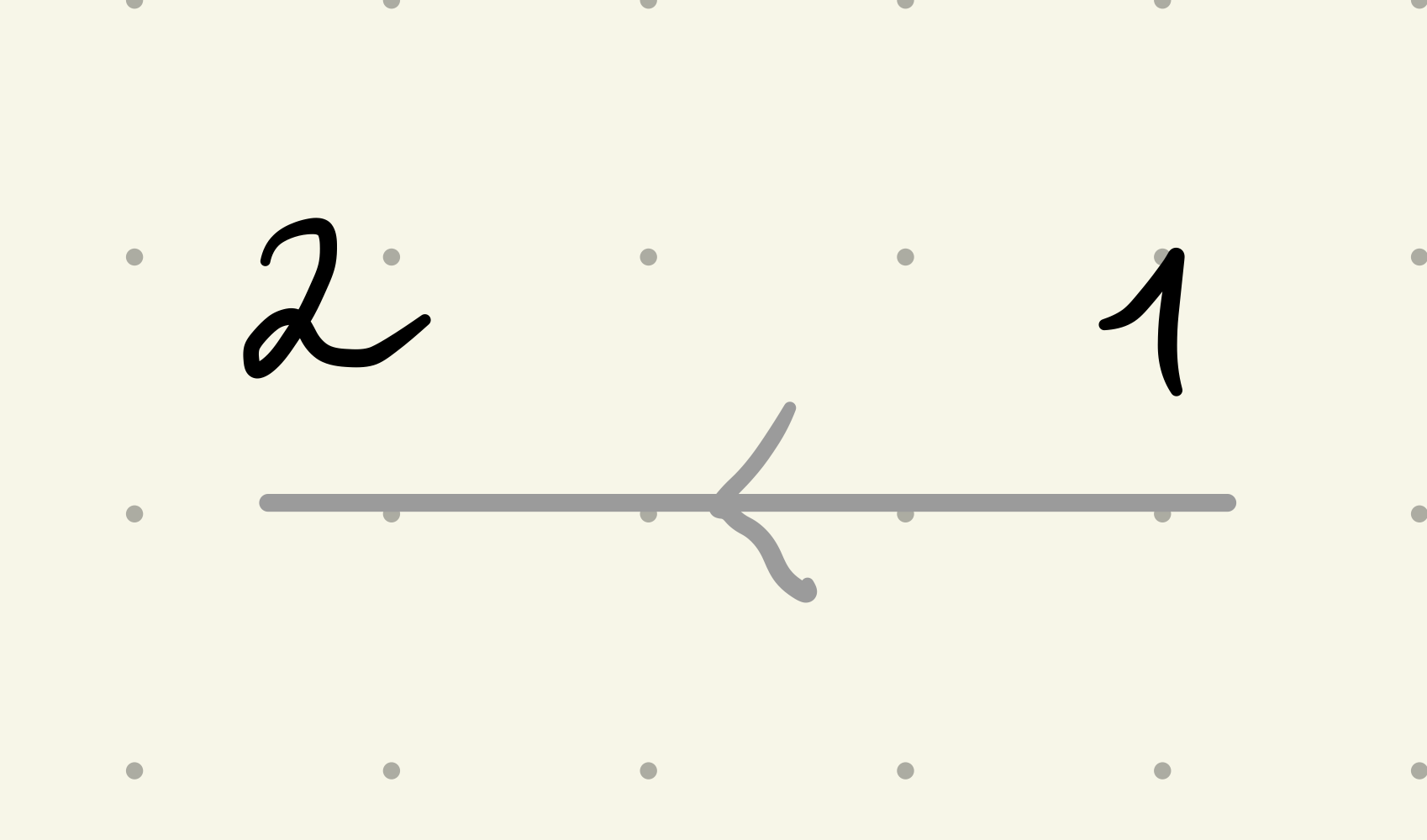
Bare propagator ¶ The bare propagator (or non-interacting Green’s function) is defined as
G 0 , 21 = − ⟨ c 2 c ˉ 1 ⟩ 0 = − ∫ D [ c ˉ , c ] c 2 c ˉ 1 e − S 0 ∫ D [ c ˉ , c ] e − S 0 , \begin{align}
G_{0,21} = -\langle c_2 \bar{c}_1 \rangle_0 = - \frac{\int\mathcal{D}[\bar{c}, c] c_2 \bar{c}_1 e^{-S_0}}{\int\mathcal{D}[\bar{c}, c] e^{-S_0}}\, ,
\end{align} G 0 , 21 = − ⟨ c 2 c ˉ 1 ⟩ 0 = − ∫ D [ c ˉ , c ] e − S 0 ∫ D [ c ˉ , c ] c 2 c ˉ 1 e − S 0 , where the subscript “0” indicates that the expectation value is taken with respect to the non-interacting action. It is represented diagrammatically as
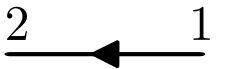
Propagator ¶ The fully interacting one-particle propagator (or Green’s function) is the two-point correlation function defined as
G 21 = − ⟨ c 2 c ˉ 1 ⟩ = − 1 Z ∫ D [ c ˉ , c ] c 2 c ˉ 1 e − S . \begin{align}
G_{21} = -\langle c_2 \bar{c}_1 \rangle = - \frac{1}{Z} \int \mathcal{D}[\bar{c}, c] c_2 \bar{c}_1 e^{-S} \, .
\end{align} G 21 = − ⟨ c 2 c ˉ 1 ⟩ = − Z 1 ∫ D [ c ˉ , c ] c 2 c ˉ 1 e − S . where (imaginary) time-ordering is implied. It is represented diagrammatically as
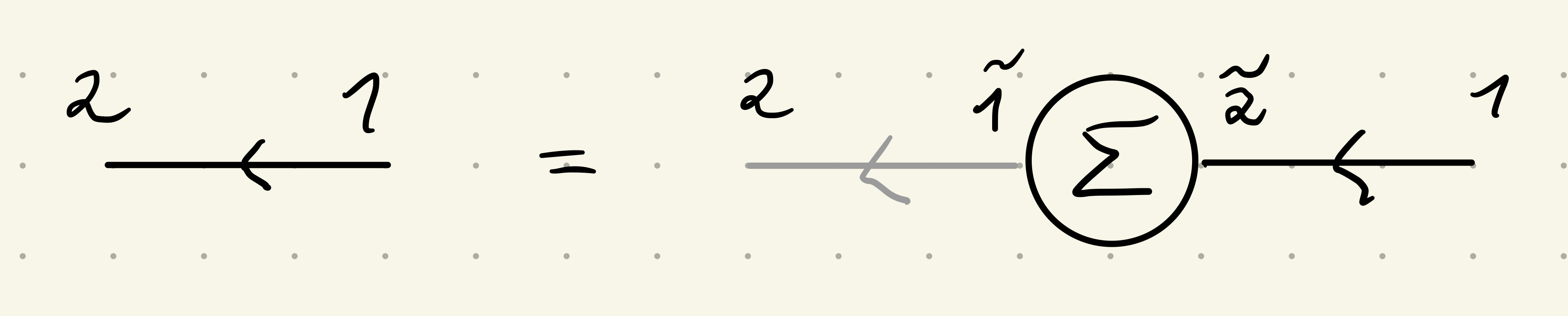
Self-energy ¶ The main two-point quantity to compute in many-body theory is the one-particle irreducible two-point vertex, also called self-energy Σ \Sigma Σ
G 21 = G 0 , 21 + G 0 , 2 1 ~ Σ 1 ~ 2 ~ G 2 ~ 1 ⇔ G 12 − 1 = ( G 0 ) 12 − 1 − Σ 12 , \begin{align}
G_{21} = G_{0,21} + G_{0,2\tilde{1}} \Sigma_{\tilde{1}\tilde{2}} G_{\tilde{2}1} \quad \Leftrightarrow \quad G^{-1}_{12} = (G_0)^{-1}_{12} - \Sigma_{12} \, ,
\end{align} G 21 = G 0 , 21 + G 0 , 2 1 ~ Σ 1 ~ 2 ~ G 2 ~ 1 ⇔ G 12 − 1 = ( G 0 ) 12 − 1 − Σ 12 , which is represented diagrammatically as
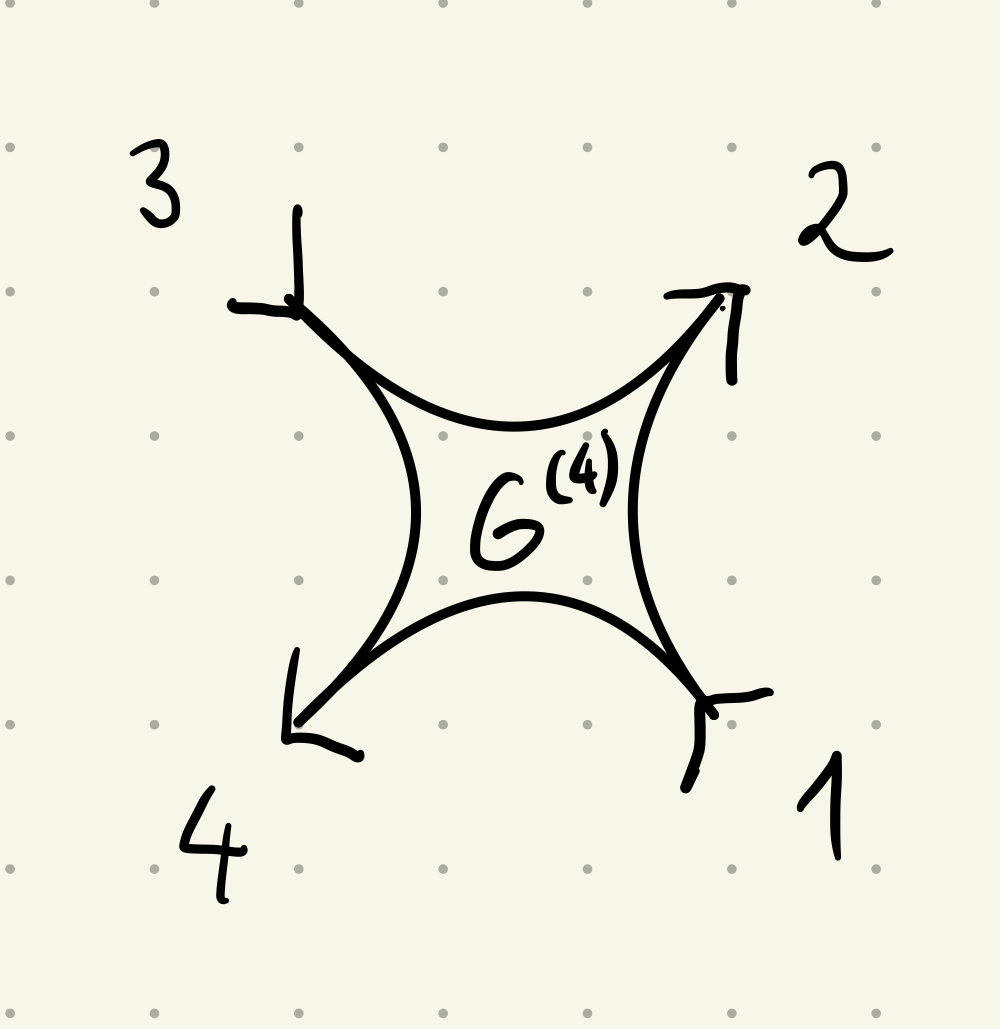
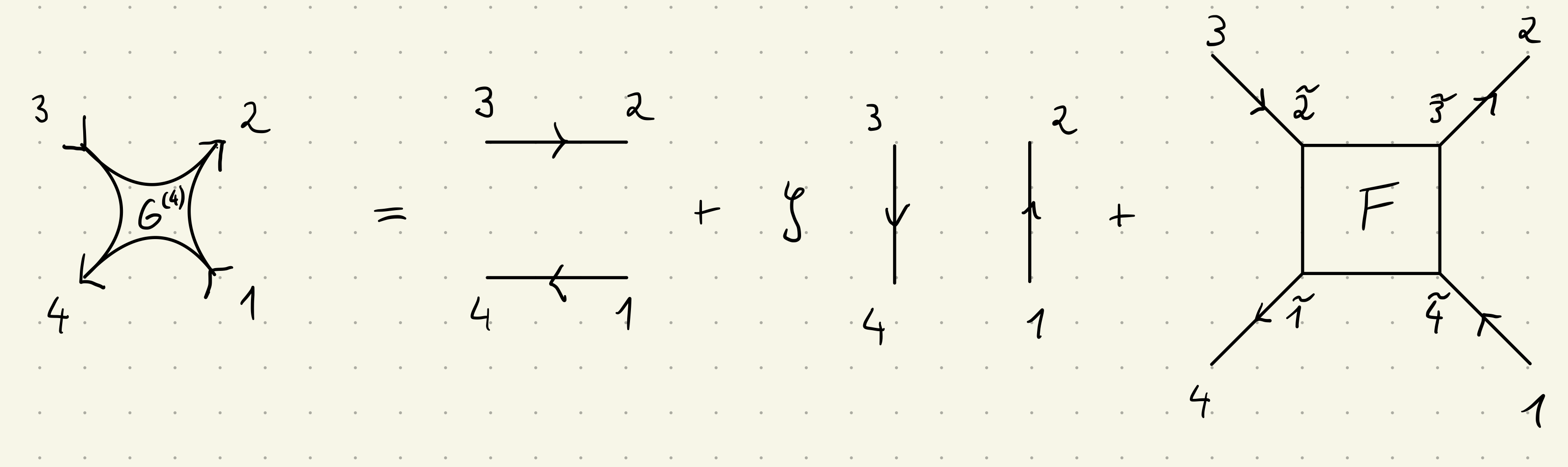
Four-point correlation function ¶ The four-point correlation function is defined as
G 4321 ( 4 ) = ⟨ c 4 c 2 c ˉ 3 c ˉ 1 ⟩ = 1 Z ∫ D [ c ˉ , c ] c 4 c 2 c ˉ 3 c ˉ 1 e − S , \begin{align}
G^{(4)}_{4321} = \langle c_4 c_2 \bar{c}_3 \bar{c}_1 \rangle = \frac{1}{Z} \int \mathcal{D}[\bar{c}, c] c_4 c_2 \bar{c}_3 \bar{c}_1 e^{-S} \, ,
\end{align} G 4321 ( 4 ) = ⟨ c 4 c 2 c ˉ 3 c ˉ 1 ⟩ = Z 1 ∫ D [ c ˉ , c ] c 4 c 2 c ˉ 3 c ˉ 1 e − S , and represented diagrammatically by the flying squirrel diagram (credit: Marcel Gievers),
Note that in general, the order of multi-indices in correlation functions (such as G G G G ( 4 ) G^{(4)} G ( 4 ) Σ \Sigma Σ F F F
Some papers define the four-point correlation function with a different ordering of the operators as
G ~ 1234 ( 4 ) = ⟨ c 1 c ˉ 2 c 3 c ˉ 4 ⟩ , \begin{align}
\tilde{G}^{(4)}_{1234} = \langle c_1 \bar{c}_2 c_3 \bar{c}_4 \rangle \, ,
\end{align} G ~ 1234 ( 4 ) = ⟨ c 1 c ˉ 2 c 3 c ˉ 4 ⟩ , We can make contact with that convention by relabeling the indices in our definition of G ( 4 ) G^{(4)} G ( 4 )
G 1234 ( 4 ) = ⟨ c 1 c 3 c ˉ 2 c ˉ 4 ⟩ = ζ ⟨ c 1 c ˉ 2 c 3 c ˉ 4 ⟩ . \begin{align}
G^{(4)}_{1234} = \langle c_1 c_3 \bar{c}_2 \bar{c}_4 \rangle = \zeta \langle c_1 \bar{c}_2 c_3 \bar{c}_4 \rangle\, .
\end{align} G 1234 ( 4 ) = ⟨ c 1 c 3 c ˉ 2 c ˉ 4 ⟩ = ζ ⟨ c 1 c ˉ 2 c 3 c ˉ 4 ⟩ . Here, the factor ζ = − 1 \zeta = -1 ζ = − 1 ζ = + 1 \zeta = +1 ζ = + 1 c 3 c_3 c 3 c ˉ 2 \bar{c}_2 c ˉ 2
We can write down the tree expansion for the four-point function as
G 4321 ( 4 ) = G 41 G 23 + ζ G 43 G 21 + G 4 1 ~ G 2 3 ~ F 1 ~ 2 ~ 3 ~ 4 ~ G 2 ~ 3 G 4 ~ 1 . \begin{align}
G^{(4)}_{4321} = G_{41} G_{23} + \zeta G_{43} G_{21} + G_{4\tilde{1}} G_{2\tilde{3}} F_{\tilde{1}\tilde{2}\tilde{3}\tilde{4}} G_{\tilde{2}3} G_{\tilde{4}1}\,.
\end{align} G 4321 ( 4 ) = G 41 G 23 + ζ G 43 G 21 + G 4 1 ~ G 2 3 ~ F 1 ~ 2 ~ 3 ~ 4 ~ G 2 ~ 3 G 4 ~ 1 . The third term, G c , 4321 ( 4 ) = G 4 1 ~ G 2 3 ~ F 1 ~ 2 ~ 3 ~ 4 ~ G 2 ~ 3 G 4 ~ 1 G^{(4)}_{c,4321} = G_{4\tilde{1}} G_{2\tilde{3}} F_{\tilde{1}\tilde{2}\tilde{3}\tilde{4}} G_{\tilde{2}3} G_{\tilde{4}1} G c , 4321 ( 4 ) = G 4 1 ~ G 2 3 ~ F 1 ~ 2 ~ 3 ~ 4 ~ G 2 ~ 3 G 4 ~ 1 connected four point correlator . This expression defines the full four-point vertex F F F
Derive this expression. Can motivate it, for example, from the first contributions in perturbation theory, utilizing Wick’s theorem. See Jan’s handwritten notes for reference.
See also the note which basically does exactly that in the Keldysh formalism.
It may look odd at first to write the indices in reverse order for the propagator and the four-point function. Indeed, one could have written
G 1234 ( 4 ) = ⟨ c 1 c 3 c ‾ 2 c ‾ 4 ⟩ G^{(4)}_{1234} = \langle c_1 c_3 \overline{c}_2 \overline{c}_4 \rangle G 1234 ( 4 ) = ⟨ c 1 c 3 c 2 c 4 ⟩ G 12 = − ⟨ c 1 c ‾ 2 ⟩ G_{12} = - \langle c_1 \overline{c}_2 \rangle G 12 = − ⟨ c 1 c 2 ⟩ c ‾ \overline{c} c c c c
This structure is (almost) preserved when connecting vertices via propagator lines in diagrammatic expressions, as can already be seen in second order perturbation theory p p pp pp
Note that, as a consequence of this convention, the order of indices in the self-energy Σ \Sigma Σ F F F G G G G ( 4 ) G^{(4)} G ( 4 )